Application matrix

Klein Tools Multimeter choices by electrical work context

Begin with the installation location and signal, then compare functions, measurement category, range, accuracy, waveform response, access, and environmental limits.

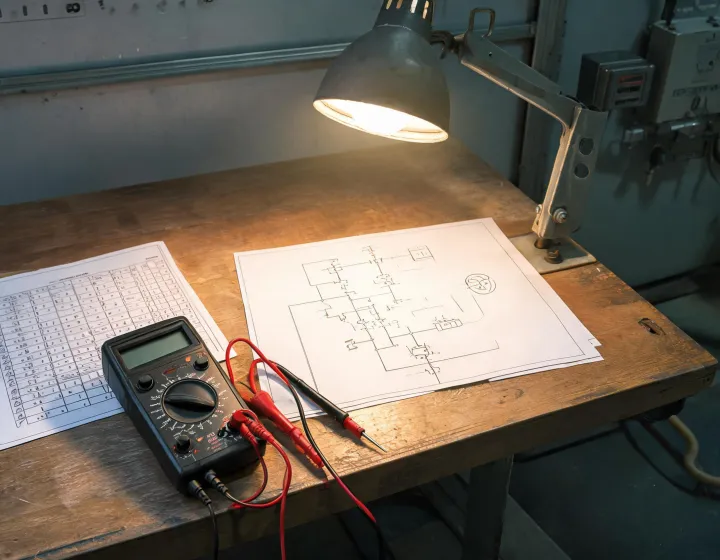
Klein Tools multimeter applications in a panel and controls workspace

Match the instrument to the installation

Commercial wiring and panels

Receptacle circuits, lighting controls, feeders, and distribution equipment present different transient environments. CAT marking must be read with its voltage and test-point location. The meter, leads, probes, and clips form one system, limited by its lowest-rated connected part.

Industrial controls and motors

PLC supplies, contactor coils, sensors, and variable frequency drives can introduce distorted or switched waveforms. True-RMS response, bandwidth, crest-factor limits, min/max capture, and any low-pass method should be checked in the exact model instructions.

HVAC and refrigeration

Capacitance, temperature, microamp flame-sensor current, inrush, and clamp measurements may reduce tool changes. Not every handheld meter measures each variable directly, so sensor interface, clamp range, access, and stated test method belong in the shortlist.

Electronics and bench service

Low-energy circuits may prioritize resolution, input impedance, diode behavior, capacitance range, and fine probe access. A higher installation category does not automatically make a meter more suitable for low-level board work.

Technician checking a motor control circuit

Case path: a drive-fed motor symptom

The background is an intermittent speed complaint at a motor controlled by a variable frequency drive. The process separates input supply checks, control-voltage checks, and any drive-output measurement because each point presents a different waveform and interpretation method. The result is not a blanket meter recommendation: it is a list of required functions, expected ranges, bandwidth questions, CAT context, lead needs, and manual sections to verify before work.

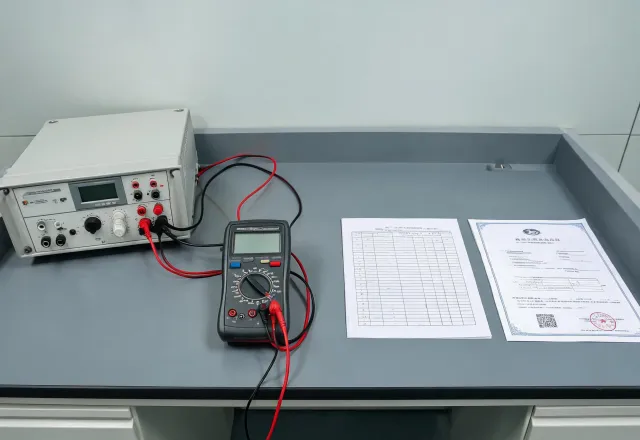
Calibration bench for a handheld digital multimeter

Case path: maintenance tolerance control

The background is a preventive-maintenance procedure with a defined voltage tolerance. Review covers the complete accuracy expression, selected range, resolution, temperature condition, calibration status, and reference traceability. The result records whether published performance supports the procedure and what acceptance criteria remain under the site quality system. Display counts alone are not treated as proof.

Two trade-offs worth keeping visible

Accuracy versus category: accuracy addresses reading uncertainty under defined conditions, while category addresses transient exposure by installation location. Neither replaces the other. Direct current input versus clamp measurement: a direct input can offer different low-current resolution, but opening a circuit changes the work method; a compatible clamp avoids direct insertion yet has its own range, accuracy, jaw-access, and waveform limitations.

Environmental limits also matter. Temperature, humidity, ingress exposure, crest factor, frequency, battery state, common-mode conditions, and lead arrangement can alter what a reading means. Never exceed published inputs or substitute an arbitrary fuse.

Need help defining the test point?

Use the Selection Guide

Ready to compare model families?

Request a Review